BGP-VPLS Configuration
This chapter contains configurations for VPLS with Border Gateway Protocol (BGP) Signaling.
Virtual Private LAN Service (VPLS) provides Ethernet-based multipoint-to-multipoint communication over IP/MPLS networks. It allows sites that are geographically separated to share an Ethernet broadcast domain by connecting sites through pseudowires. For instance, a set of Kompella circuits is grouped by a common VPLS identifier to achieve this service objective.
A Pseudowire (PW) consists of a pair of point-to-point, single-hop, unidirectional LSPs, placed in opposite directions, each identified by a PW label, also referred to as a Virtual Connection (VC) label.
BGP is used to signal the VCs and for auto-discovery of neighbors. A service provider may use either LDP or RSVP-TE or add static provisioning to set up LSP tunnels for data transport through virtual circuits.
The VPLS identifier is exchanged with the labels, and both PWs are linked and associated with a particular VPLS instance.
In Inter-AS, OcNOS accepts information from any other AS but the same VPN-ID/VPLS-ID ( *: VPLS-ID). OcNOS does not have explicit RD/RT (import/export) support for BGP VPLS. RD/RT are automatically generated based on the configured BGP AS number and VPN-ID/VPLS-ID as (AS-number: VPN-ID).
In OcNOS, only the RD/RT format of AS:NN (Autonomous System:Number) is supported. The IP:NN (IP address:Number) format is not supported.
Topology
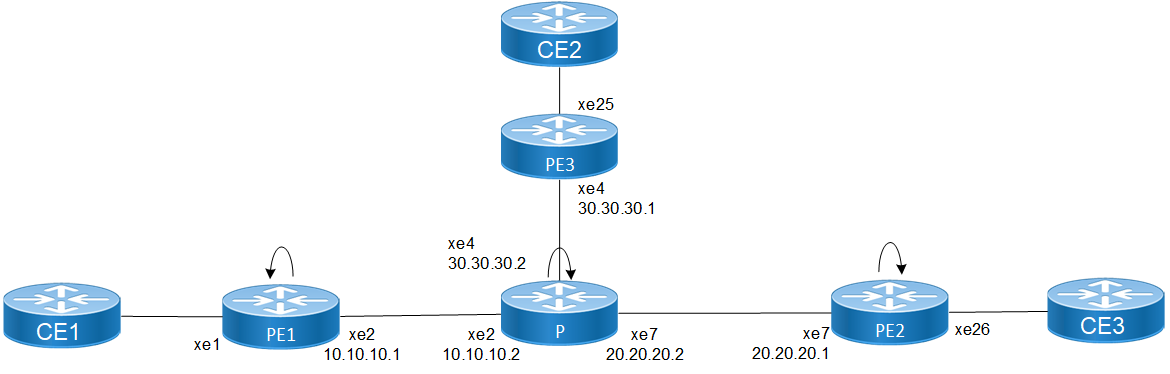
The diagram depicts the topology for the configuration examples that follow.
Figure 48. Sample Topology for VPLS with BGP Signaling