EVPN MPLS E-Tree
Overview
Ethernet VPN Ethernet-Tree (EVPN E-Tree), is a networking solution designed to manage communication within broadcast domains, incorporating redundancy through multi-homing in a network. It optimizes traffic routing and control, especially in scenarios where specific services or devices need controlled communication. It categorizes network nodes based on predefined definitions of EVPN Instances as Leaf or Root, allowing or restricting communication between them.
Feature Characteristics
Implemented Scenario 1 of the EVPN E-Tree solution, as defined by RFC-8317, designates each Provider Edge (PE) node as either a Leaf or a Root site per Virtual Private Network (VPN) for VXLAN
Scenario 1: Leaf or Root Site(s) per PE
Scenario 1 involves a topology with three PE nodes: PE-1, PE-2, and PE-3. PE-1 and PE-2 are Multi-Homed nodes (MH-1 and MH-2), with PE-3 acting as the Root node. PE-1 and PE-2 function as Leaf nodes and are part of a single home access interface (SH1 and SH2).
Figure 10. EVPN E-Tree
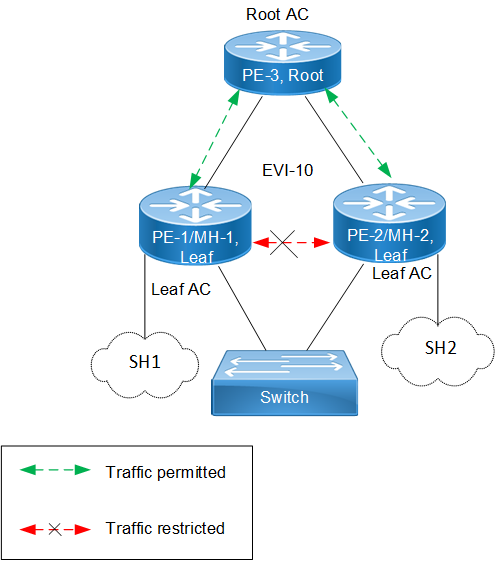
The classification ensures that communication follows specific rules:
| • | Communication between Leaf hosts is restricted, as indicated by red dotted lines with a cross mark (X) in the topology diagram. However, communication between Leaf and Root nodes, as well as between Root nodes, is permitted, marked by green dotted lines. |
| • | Leaf nodes within PE-1 and PE-2 are isolated from each other, preventing intra-PE communication. |
The scenario 1 is achieved through two main concepts:
| 1. | Inter-PE Communication |
| • | The inter-PE Route Target (RT) Constraint Method is applicable only to Single-Homing (SH) devices. Two RTs per broadcast domain are utilized, with Leaf PEs exporting Leaf RTs and Root nodes exporting Root RTs. Leaf nodes import only Root RTs, allowing communication with Root PEs while preventing communication with other Leaf nodes. RT constraints limit the import of specific EVPN routes (MAC-IP and IMET routes) to designated paths for inter-PE communication. |
| • | IPI employs a proprietary method to support inter-PE connectivity for both SH and MH devices, using BGP extended community to advertise Leaf Indication in BGP routes and influence traffic flow for both Unicast and BUM traffic. This method enables implementation of ARP or ND cache suppression and MAC mobility sub-features specified in RFC-7432. |
| 2. | Intra-PE communication: Local Split Horizon controls intra-PE communication between Attachment Circuits (ACs) within Leaf PE nodes, ensuring that traffic between ACs does not egress to other Leaf ACs. |
This functionality depends on hardware capabilities.
Benefits
EVPN E-Tree offers benefits in networking environments by providing efficient traffic control, enhanced security, scalability, and improved performance.
Efficient Traffic Control: EVPN E-Tree allows for efficient control over traffic within network broadcast domains. By segregating nodes into Leaf and Root categories, it enables precise management of communication flows, ensuring the traffic is directed only where needed.
Enhanced Security: The isolation of Leaf hosts from each other adds a layer of security to the network. This prevents unauthorized communication between devices within the same broadcast domain, reducing the risk of data breaches and unauthorized access.
Scalability: EVPN E-Tree is scalable, making it suitable for networks of various sizes and complexities. Whether deploying in small-scale environments or large enterprise networks, EVPN E-Tree offers flexibility and scalability to meet evolving business needs.
Improved Performance: By controlling communication paths and optimizing traffic flows, EVPN E-Tree can improve network performance. This ensures that critical data packets are delivered efficiently, reducing latency and enhancing overall network performance.