Configuration
This section shows the configuration of the DHCPv6 prefix delegation.
Topology
The requesting router sends the prefix request to the delegating router, which sends the request to the DHCP server. The DHCP server sends the prefix to the requesting router through the delegating router. The IPv6 address is created in the requesting router by combining the prefix learned from the server and the user-defined suffix. The host receives the IPv6 address from the requesting router.
Figure 31. DHCPv6 Prefix Delegation Configuration
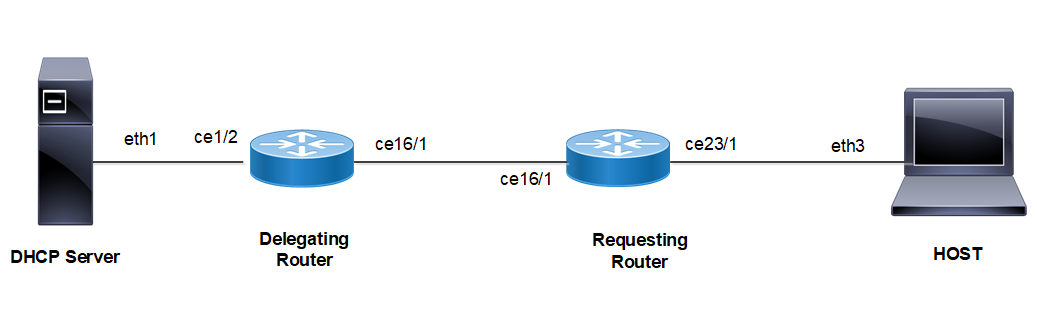
Configuring DHCP prefixes
Follow the steps to configure the DHCPv6 prefix delegation.
Configure the Delegating Router
-
Specify the server interface address connected to the delegating router.
Copy(config)#ipv6 dhcp relay address 2001:101:0:1::131 -
Configure the DHCPv6 up-link interface from the delegating router to the DHCPv6 server using
ipv6 dhcp relay uplinkcommand.Copy(config)#interface ce1/2
(config-if)#ipv6 address 2001:101:0:1::130/64
(config-if)#ipv6 dhcp relay uplink -
Configure the DHCPv6 down-link interface from the delegating router to the requesting router using
ipv6 dhcp relaycommand.Copy(config)#interface ce16/1
(config-if)#ipv6 address 3001:101:0:1::135/64
(config-if)#ipv6 dhcp relay -
Add a static route on the delegating router to reach the host device.
Copy(config)#ipv6 route ::/0 3001:101:0:1::
Configure the Requesting Router device
-
In the WAN interface, configure the address prefix length option (
64). Get the IPv6 address from the server usingipv6 address dhcpcommand. Enable the requesting router to request the prefix by usingipv6 dhcp prefix-delegationand configure the number of prefixes usingipv6 dhcp client max-delegated-prefixes.- The default value of simultaneous prefixes delegated to a single client is 8. The minimum of simultaneous prefixes delegated to a single client is 1 and the maximum is 64.
- If the configured
max-delegated-prefix countis greater than 30, then configure the lease times greater than 180 seconds.
Copy(config)#interface ce16/1
(config-if)#ipv6 dhcp address-prefix-len 64
(config-if)#ipv6 address dhcp
(config-if)#ipv6 dhcp prefix-delegation PREFIX_FROM_SERVER
(config-if)#ipv6 dhcp client max-delegated-prefixes 10 -
In the LAN interface, configure the command
ipv6 addressto create the IPv6 address by using the DHCP prefix learned from the server and user defined suffix.Copy(config)#interface ce23/1
(config-if)#ipv6 address PREFIX_FROM_SERVER ::1:0:0:0:1/64 -
Add a static route on the requesting router to reach the host device.
Copy(config)#ipv6 route 2001:101:0:1::/64 3001:101:0:1::135
Configure the HOST
-
In the LAN interface, configure the auto-configuration to get the dynamic IPv6 address from the server.
Copy(config)#interface eth3
(config-if)#ipv6 address autoconfig max-address 10
(config if)#exit
(config)#commit -
Add a static route on the host to reach the server.
Copy(config)#ipv6 route 2001:101:0:1::/64 3001:101:0:1::135
Running configurations
The running configuration for the Delegating Router is as follows:
#show running-config
!
ipv6 dhcp relay address 2001:101:0:1::131
!
interface ce1/2
 ipv6 address 2001:101:0:1::130/64
 ipv6 dhcp relay uplink
!
interface ce16/1
 ipv6 address 3001:101:0:1::135/64
 ipv6 dhcp relay
 commit
 end
!
The running configuration for the Requesting Router is as follows:
#show running-config
!
interface ce16/1
 ipv6 dhcp client max-delegated-prefixes 10
 ipv6 address dhcp
 ipv6 dhcp address-prefix-len 64
 ipv6 dhcp prefix-delegation PREFIX_FROM_SERVER
!
interface ce23/1
 ipv6 address PREFIX_FROM_SERVER ::1:0:0:0:1/64
 commit
 end
!
The running configuration for the HOST is as follows:
#show running-config
!
interface eth3
 ipv6 address autoconfig max-address 10
 commit
 end
!
Validation
Validate the show output after configuration as shown below.
Delegating Router
#show ipv6 route
IPv6 Routing Table
Codes: K - kernel route, C - connected, S - static, D- DHCP, R - RIP,
       O - OSPF, IA - OSPF inter area, E1 - OSPF external type 1,
       E2 - OSPF external type 2, E - EVPN  N1 - OSPF NSSA external type 1,
       N2 - OSPF NSSA external type 2, i - IS-IS, B - BGP,
       v - vrf leaked
Timers: Uptime

IP Route Table for VRF "default"
C       ::1/128 via ::, lo, 00:03:20
C       2001:101:0:1::/64 via ::, ce1/2, 00:02:58
D       2001:db9:c0f::/48 [80/0] via fe80::eac5:7aff:fe51:723b, ce16/1, 00:00:44
C       3001:101:0:1::/64 via ::, ce16/1, 00:00:50
C       fe80::/64 via ::, ce16/1, 00:00:50
#show ipv6 dhcp pd-route
VRF : default
  2001:db9:c0a::/48 via 2001:db9:c0b::, ce16/1, (2024-03-07 06:20:43 - 2024-03-07 06:22:13)
  2001:db9:c0b::/48 via 2001:db9:c09::, ce16/1, (2024-03-07 06:20:42 - 2024-03-07 06:22:12)
  2001:db9:c0c::/48 via 2001:db9:c0d::, ce16/1, (2024-03-07 06:20:39 - 2024-03-07 06:22:09)
  2001:db9:c0d::/48 via 2001:db9:c0e::, ce16/1, (2024-03-07 06:20:38 - 2024-03-07 06:22:08)
  2001:db9:c0e::/48 via 2001:db9:c0f::, ce16/1, (2024-03-07 06:20:37 - 2024-03-07 06:22:07)
  2001:db9:c0f::/48 via fe80::eac5:7aff:fe51:723b, ce16/1, (2024-03-07 06:20:36 - 2024-03-07 06:22:06)
  2001:db9:c05::/48 via 2001:db9:c06::, ce16/1, (2024-03-07 06:20:45 - 2024-03-07 06:22:15)
  2001:db9:c06::/48 via 2001:db9:c0a::, ce16/1, (2024-03-07 06:20:44 - 2024-03-07 06:22:14)
  2001:db9:c08::/48 via 2001:db9:c0c::, ce16/1, (2024-03-07 06:20:40 - 2024-03-07 06:22:10)
  2001:db9:c09::/48 via 2001:db9:c08::, ce16/1, (2024-03-07 06:20:41 - 2024-03-07 06:22:11)
#show ipv6 dhcp relay
IPv6 DHCP relay service is Enabled.
VRF Name: default
  DHCPv6 Servers configured:
  2001:101:0:1::131
  DHCPv6 IA_PD Route injection: Enabled
  DHCPv6 Duplicate Clients detection: Disabled
  Interface                Uplink/Downlink
  ---------                -------------
  ce16/1                   Downlink
  ce1/2                    Uplink
Requesting Router
#show ipv6 dhcp interface

ce16/1 is in client mode
        prefix name: PREFIX_FROM_SERVER
        learned prefix: 2001:db9:c05::/48
        preferred lifetime 0, valid lifetime 60
        interfaces using the learned prefix
                ce23/1    2001:db9:c0f:1::1
                ce23/1    2001:db9:c0e:1::1
                ce23/1    2001:db9:c0d:1::1
                ce23/1    2001:db9:c0c:1::1
                ce23/1    2001:db9:c08:1::1
                ce23/1    2001:db9:c09:1::1
                ce23/1    2001:db9:c0b:1::1
                ce23/1    2001:db9:c0a:1::1
                ce23/1    2001:db9:c06:1::1
                ce23/1    2001:db9:c05:1::1

#show interface ce23/1
Interface ce23/1
  Flexport: Non Control Port (Active)
  Hardware is ETH  Current HW addr: e8c5.7a51.722e
  Physical:e8c5.7a51.722e  Logical:(not set)
  Forward Error Correction (FEC) configured is Auto (default)
  FEC status is N/A
  Port Mode is Router
  Protected Mode is Promiscuous
  Interface index: 10017
  Metric 1 mtu 1500 duplex-full  link-speed 10g
  Debounce timer: disable
  ARP ageing timeout 1500
  <UP,BROADCAST,RUNNING,ALLMULTI,MULTICAST>
  VRF Binding: Not bound
  Label switching is disabled
  No Virtual Circuit configured
  Administrative Group(s): None
  Bandwidth 10g
  Maximum reservable bandwidth 10g
    Available b/w at priority 0 is 10g
    Available b/w at priority 1 is 10g
    Available b/w at priority 2 is 10g
    Available b/w at priority 3 is 10g
    Available b/w at priority 4 is 10g
    Available b/w at priority 5 is 10g
    Available b/w at priority 6 is 10g
    Available b/w at priority 7 is 10g
  DHCP client is disabled.
  Last Flapped: Never
  Statistics last cleared: Never
  inet6 2001:db9:c05:1::1/64
  inet6 2001:db9:c06:1::1/64
  inet6 2001:db9:c08:1::1/64
  inet6 2001:db9:c09:1::1/64
  inet6 2001:db9:c0a:1::1/64
  inet6 2001:db9:c0b:1::1/64
  inet6 2001:db9:c0c:1::1/64
  inet6 2001:db9:c0d:1::1/64
  inet6 2001:db9:c0e:1::1/64
  inet6 2001:db9:c0f:1::1/64
  inet6 fe80::eac5:7aff:fe51:722e/64
  ND router advertisements are sent approximately every 561 seconds
  ND next router advertisement due in 517 seconds.
  ND router advertisements live for 1800 seconds
  Hosts use stateless autoconfig for addresses.
  5 minute input rate 82 bits/sec, 0 packets/sec
  5 minute output rate 191 bits/sec, 0 packets/sec
  RX
    unicast packets 0 multicast packets 25 broadcast packets 0
    input packets 25 bytes 2862
    jumbo packets 0
    undersize 0 oversize 0 CRC 0 fragments 0 jabbers 0
    input error 0
    input with dribble 0 input discard 0
    Rx pause 0
  TX
    unicast packets 0 multicast packets 38 broadcast packets 0
    output packets 38 bytes 5540
    jumbo packets 0
    output errors 0 collision 0 deferred 0 late collision 0
    output discard 0
    Tx pause 0
HOST
#show ipv6 interface eth3 brief
Interface            IPv6-Address                                      Admin-Status
eth3                 2001:db9:c05:1:923c:b3ff:fe90:9fa9
                     2001:db9:c06:1:923c:b3ff:fe90:9fa9
                     2001:db9:c08:1:923c:b3ff:fe90:9fa9
                     2001:db9:c09:1:923c:b3ff:fe90:9fa9
                     2001:db9:c0a:1:923c:b3ff:fe90:9fa9
                     2001:db9:c0b:1:923c:b3ff:fe90:9fa9
                     2001:db9:c0c:1:923c:b3ff:fe90:9fa9
                     2001:db9:c0d:1:923c:b3ff:fe90:9fa9
                     2001:db9:c0e:1:923c:b3ff:fe90:9fa9
                     2001:db9:c0f:1:923c:b3ff:fe90:9fa9
                     fe80::923c:b3ff:fe90:9fa9                         [up/up]
Glossary
The following provides definitions for key terms or abbreviations and their meanings used throughout this document:
|
Key Terms/Acronym |
Description |
|---|---|
|
Border Network Gateway (BNG) |
Border Network Gateway is a critical component in the telecommunication network that serves as the entry and exit point between the ISP and the global network. |
|
Customer Premises Equipment (CPE) |
Customer Premises Equipment is a networking device located on the customer premises. It is present on the edge of the service provider network, which connects the customer devices to the service provider network. |
|
Delegating Router (DR) |
Delegating Router is a network device that delegates the IPv6 address prefixes to the downstream devices. |
|
Identity association for non-temporary addresses (IA_NA) |
Identity association for non-temporary addresses is a unique identifier associated with a set of IPv6 addresses assigned to client devices permanently or for a long time. |
|
Local Area Network (LAN) |
Local Area Network is a network of devices in a small area that may include a building or home. |
|
Neighbor Discovery Protocol (NDP) |
Neighbor Discovery Protocol is a crucial protocol in the IPv6 networks, helping establish the communication and auto-configuration to run the devices in the local network segment seamlessly. |
|
Neighbor Discovery Router Advertisement (NDRA) |
Neighbor Discovery Router Advertisement facilitates a network device to advertise the routing information with the neighboring devices so that the neighboring devices take the forwarding decision in dynamic routing. |
|
Router Advertisement (RA) |
Router Advertisement is a critical component in the IPv6 network. The router sends a message to the devices connected to the LAN to communicate its presence and share the configurations with the LAN host. |
|
Requesting Router (RR) |
Requesting Router is a network device that requests the IPv6 address prefixes to the DHCP server to share it with the downstream devices. |
|
Router Solicitation (RS) |
Router Solicitation is a component of the neighbor discovery protocol in the IPv6 network where the host sends a message to discover routers in the local area. When a router receives RS, it responds to the host with RA, which includes the configuration. |
|
Wide Area Network (WAN) |
Wide Area Network refers to large network that includes multiple LANs and spans over a large geographical area. |