ECMP Support for L3EVPN
Overview
Equal Cost Multipath (ECMP) for L3EVPN helps in load-balancing the EVPN IRB traffic. It supports traffic on all the IP paths that are available in an MPLS based EVPN network with a symmetric IRB (S-IRB) configuration. This feature programs IP prefix advertisements received on multiple BGP paths into the forwarding plane, enabling ECMP load balancing of known unicast inter-subnet IP traffic.
Feature Characteristics
This feature supports the MPLS-based symmetric IRB (S-IRB) configuration between peer PEs to configure IP multipaths in forwarding-plane.
It applies specifically to MPLS-based EVPN deployments
In the below image, the PE routers PE1 and PE2 learn IPv4 and IPv6 customer subnet routes from connected CE device into the corresponding EVPN MAC-VRF via VLAN-based or VLAN-aware bundle service interface. These PE devices' configurations have MAC-VRF connected to an IP-VRF via IRB interface. The protocol BGP running on these PE devices advertise the IRB IP/MAC, CE host IP/MAC, and customer subnet IP routes to UPE as Type-2 and Type-5 (carrying L3VNI for VXLAN-based EVPN or Layer-3 label for MPLS-based EVPN) routes containing the respective IP and MAC-VRF Route Distinguishers and Route Targets.
Figure 100. L3EVPN ECMP Characteristics
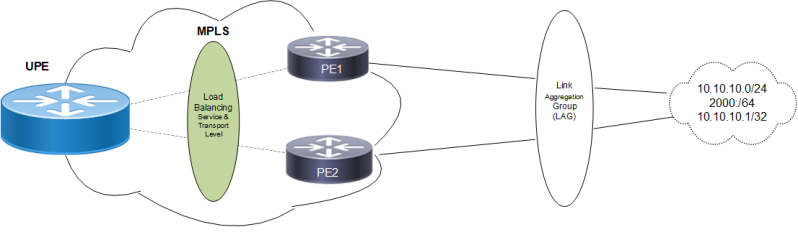
The User-facing PE (UPE) processes the advertised routes and their next-hops in its control-plane and installs them in its forwarding-plane as multipath route entries. It prepares the hashing keys based on the configured fields of the incoming traffic, and also load balances the traffic at EVPN service level (either Layer 2 or Layer 3) and independently at transport level (LDP/RSVP/SR-MPLS) .
BGP calculates the multipath routes at both RD and VRF levels and passes the route with multiple next-hops towards NSM. NSM and HSL use the existing ECMP infrastructure to install the EVPN routes with multipaths in fast path. HSL uses hierarchical Forwarding Equivalence Class (FEC) and load balances the traffic at service level, within each ECMP group among its multipath member routes.
Benefits
Multipath programming of EVPN Type-2 and Type-5 BGP multipath routes into the data plane.
Operates over MPLS transport with support for LDP, RSVP-TE, or SR-MPLS.
L3/L4 load balancing of inter-subnet known unicast traffic at EVPN IRB service level.
Limitations
Support for symmetric IRB configuration only.
Compatible with P2P transport tunnels only.
Independent L2 and L3 load-balancing—this feature focuses only on L3 (IRB) ECMP.
Supported Hardware
Qumran1, Qumran2, and J2C+ devices.
Prerequisites
| 1. | Define Interfaces and Loopback Addresses |
Configure Layer 2 interfaces such as port channel interfaces, for example po1, and assign specific IP addresses for proper identification and routing. Additionally, assign loopback IP addresses to establish essential points of connectivity.
!
interface lo
 ip address 127.0.0.1/8
 ip address 8.8.8.8/32 secondary
 ipv6 address ::1/128

interface po7
ip address 31.1.1.8/24| 2. | Configure IGP for Dynamic Routing |
Enable ISIS to facilitate dynamic routing on all nodes within the network. Define ISIS router instances to match loopback IP addresses and add network segments to ISIS areas for proper route distribution. Set up neighbor relationships using loopback IP addresses, ensuring efficient route advertisement and convergence for optimal network performance.
ISIS Configuration
router isis 1
 is-type level-2-only
 metric-style wide
 microloop-avoidance level-2
 mpls traffic-eng router-id 8.8.8.8
 mpls traffic-eng level-2
 capability cspf
 dynamic-hostname
 bfd all-interfaces
 net 49.0000.0000.0008.00
 passive-interface lo
!
interface po7
 mpls ldp-igp sync isis level-2
 isis network point-to-point
 ip router isis 1